|
Nuke binary plugins 17.1.2
|

|
|
Nuke binary plugins 17.1.2
|
|
#include <GeometryProviderI.h>
Public Member Functions | |
| virtual GeometryProviderI * | asGeometryProvider ()=0 |
| virtual Op * | getGeometryProviderOp ()=0 |
| Op * | getGeometryProviderOp () const |
| Same as getGeometryProviderOp() but const. | |
| virtual fdk::Hash | geometryComposeState (const ndk::NodeEvalContext &engineGraphContext)=0 |
| virtual fdk::Hash | geometryComposeState () |
| Same but default implementation uses the node context for the Op the interface is on. | |
| virtual fdk::Hash | geometryEditVersionState (const ndk::NodeEvalContext &engineGraphContext)=0 |
| virtual fdk::Hash | geometryEditVersionState () |
| Same but default implementation uses the node context for the Op the interface is on. | |
| virtual bool | geometryStateVaries (const ndk::NodeEvalContext &engineGraphContext)=0 |
| virtual bool | geometryStateVaries () |
| Same but default implementation uses the node context for the Op the interface is on. | |
| virtual usg::LayerRef | buildGeometryLayerForContext (const ndk::NodeEvalContext &engineGraphContext, bool appendTo=false, const fdk::TimeValueSet &sampleTimes=fdk::TimeValueSet())=0 |
| usg::LayerRef | buildGeometryLayer (bool appendTo=false, const fdk::TimeValueSet &sampleTimes=fdk::TimeValueSet()) |
| Same but uses the node context for the Op the interface is on. | |
| virtual usg::LayerRef | getGeometryLayer (const ndk::NodeEvalContext &engineGraphContext, const fdk::TimeValueSet &sampleTimes=fdk::TimeValueSet()) |
| usg::LayerRef | getGeometryLayer (const fdk::TimeValueSet &sampleTimes=fdk::TimeValueSet()) |
| Same but uses the node context for the Op the interface is on. | |
| virtual bool | canProvideGeometryStage () const |
| virtual bool | canProvideGeometryFor (const usg::Token &purpose) const |
| virtual void | buildGeometryStageForContext (usg::StageRef &stage, const usg::ArgSet &requestArgs, const ndk::NodeEvalContext &engineGraphContext, const fdk::TimeValueSet &sampleTimes=fdk::TimeValueSet()) |
| void | buildGeometryStage (usg::StageRef &stage, const usg::ArgSet &requestArgs, const fdk::TimeValueSet &sampleTimes=fdk::TimeValueSet()) |
| Same but uses the node context for the Op the interface is on. | |
| virtual usg::StageRef | getGeometryStage (const ndk::NodeEvalContext &engineGraphContext, const fdk::TimeValueSet &sampleTimes=fdk::TimeValueSet()) |
| usg::StageRef | getGeometryStage (const fdk::TimeValueSet &sampleTimes=fdk::TimeValueSet()) |
| Same but uses default node context for the engine context. | |
Static Public Member Functions | |
| static void | BuildStage (usg::StageRef &stage, const usg::ArgSet &requestArgs, const OpGraphLocation &geometryProviderOp, const fdk::TimeValueSet &sampleTimes) |
| static void | BuildStage (usg::StageRef &stage, const OpGraphLocation &geometryProviderOp, const fdk::TimeValueSet &sampleTimes) |
| Same as BuildStage(OpSet) but with no request args. | |
| static void | BuildStage (usg::StageRef &stage, const OpGraphLocation &geometryProviderOp, const fdk::TimeValue &sampleTime) |
| Same as BuildStage(OpSet) but with only one sample time. | |
| static void | BuildStage (usg::StageRef &stage, const usg::ArgSet &requestArgs, const ndk::NodeEvalContext &engineGraphContext, const OpGraphLocation &geometryProviderOp, const fdk::TimeValueSet &sampleTimes) |
| static void | BuildEngineGraphContext (ndk::NodeEvalContext &engineGraphContextOut, const OpGraphLocation &geometryProviderOp, const fdk::Hash &variantId=fdk::Hash(), void *engineOwner=nullptr) |
| static void | DestroyEngines (const ndk::NodeEvalContext &engineGraphContext, const OpGraphLocation &geometryProviderOp) |
| static void | DestroyAllEngines (const ndk::NodeEvalContext &engineGraphContext) |
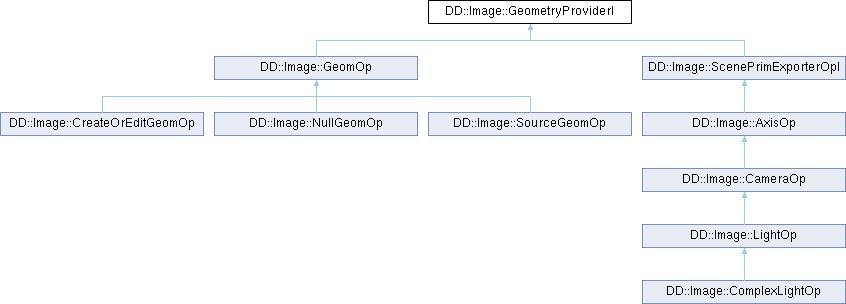
Interface class to attach to another class, usually an Op, that can provide geometry in the form of usg::Layers or a usg::Stage. Subclasses can decide to provide both a Layer and a Stage, or just a Layer. If providing both then the Layer would commonly be the root layer set in the provided Stage.
Op examples utilizing this interface are GeomOp, AxisOp (CameraOp, LightOp) and ScanlineRender2.
The returned Layer and Stage are usually local caches on the attached object as downstream consumers typically do not have persistent caches in Nuke due to the procedural graph mechanisms. A good example of this is the Viewer which contains a Stage reference but relies on each Node to store the geometry data in local Layers and provide a Stage when asked.
However the object could also pass the interface methods up the graph to an input to provide geometry if the object itself is not geometry aware. A good use of this would be an Iop with a geometry input that wants the Viewer to access the geometry passing through the Iop. ScanlineRender2 does this for example.
Note that code accessing GeometryProvider methods should be aware that it may not always be on an Op and should be able to handle null being returned from getGeometryProviderOp().
|
static |
Build the passed-in stage. If geometryProviderOp is null or sampleTimes is empty the stage is emptied.
The provider Op is typically an input to a Viewer, renderer Iop, or an Op that wants to sample geometry. Only Ops that can generate geometry (specifically a Layer or Stage) are supported, which includes GeomOps or any Op with the GeometryProviderI interface attached.
sampleTimes is the set of times to be processed/filled for the usg::Stage. A GeometryProvider should try to fulfill the requested times at a minimum, but is free to add additional time samples.
References buildGeometryStage(), DD::Image::Op::geometryProvider(), and DD::Image::OpGraphLocation::op.
Referenced by BuildStage().
|
static |
Same as BuildStage but for a graph engine owner context so the engines created and used are distinct for a specific graph context. If the context is ad-hoc/temporary (ie it has a unique short term owner) the engines will create new Layers and Stages for just this context.
Note - after using the stage be sure to call DestroyEngines() to release these temporary engines.
References buildGeometryStageForContext(), DD::Image::Op::geometryProvider(), and DD::Image::OpGraphLocation::op.
|
static |
Convenience to construct a NodeEvalContext for a geometry provider, variantId, and an optional engine owner context. The GraphScopeId is taken from the geometry provider GeomOp.
References DD::Image::OutputContext::graphScopeId(), DD::Image::OpGraphLocation::op, and DD::Image::Op::outputContext().
|
static |
Destroy all cached engines for the graph engine owner context by walking up the GeomOpEngine graph starting at geometryProviderOp. This is a companion to BuildStage(engineGraphContext) to allow custom engines to be cleaned up after use.
Note - this will never destroy the default-context engines, only custom-context engines.
References DD::Image::GeomOp::geomNode(), DD::Image::Op::geomOp(), DD::Image::Op::nodeName(), and DD::Image::OpGraphLocation::op.
|
static |
Same, but does not need an OpGraphLocation to start at. Note that this version is not as performant since Nuke must iterate through all Nodes in existence to find GeomOpNodes with the custom-context engines. It's also a sledgehammer as it's not specific to a graph subsection, ALL Nodes in all Groups will have their engines destroyed for this context.
Note - this will never destroy the default-context engines, only custom-context engines.
|
pure virtual |
Allow subclasses to gain access to sibling functions. Should return 'this'. Must implement.
Implemented in DD::Image::GeomOp, DD::Image::SceneOpI, and slr::SlrRenderOp.
|
pure virtual |
If the interface is attached to an Op return it. Should return 'this' if attached to an Op, otherwise null. Must implement.
Implemented in DD::Image::AxisSceneOp, DD::Image::CameraSceneOp, DD::Image::GeomOp, and DD::Image::LightSceneOp.
Referenced by buildGeometryLayer(), buildGeometryStage(), DD::Image::SceneOpI::extractSceneData(), geometryComposeState(), geometryEditVersionState(), geometryStateVaries(), getGeometryLayer(), and getGeometryStage().
|
pure virtual |
Compose state of output geometry at an engine context. Subclass should return a hash which represents the composition state (define geometry) of the stage it could produce. Multiple calls to this method should return exactly the same hash as long as a built stage does not need to be recomposed.
Must implement.
Implemented in DD::Image::GeomOp, and DD::Image::SceneOpI.
|
virtual |
Same but default implementation uses the node context for the Op the interface is on.
Reimplemented in DD::Image::GeomOp.
References geometryComposeState(), and getGeometryProviderOp().
Referenced by buildGeometryStageForContext(), and geometryComposeState().
|
pure virtual |
Edit version state of output layer(s) for an engine context. Subclass should return a hash which represents the edit version state (modify values) of the layers it will produce. Multiple calls to this method should return exactly the same hash as long as the resulting Layer attribute can be value-modified without changing its definition, which is a composition change and should be reflected in the geometryComposeState(engineGraphContext). When this version hash changes the contents of all attributes in the layer are likely invalid and any existing time samples cleared out.
Must implement.
Implemented in DD::Image::GeomOp, and DD::Image::SceneOpI.
|
virtual |
Same but default implementation uses the node context for the Op the interface is on.
Reimplemented in DD::Image::GeomOp.
References geometryEditVersionState(), and getGeometryProviderOp().
Referenced by geometryEditVersionState().
|
pure virtual |
Does the geometry state have contributions from an animating source at this engine context? A subclass should either return true if it doesn't know for certain, or determine the animation state from local parameters and input info.
This is only a hint to downstream nodes that the per-frame evaluated hash state of an Op will -likely- vary, it does not indicate that the actual geometry data -does- vary over time.
Must implement.
Implemented in DD::Image::GeomOp, and DD::Image::SceneOpI.
|
virtual |
Same but default implementation uses the node context for the Op the interface is on.
Reimplemented in DD::Image::GeomOp.
References geometryStateVaries(), and getGeometryProviderOp().
Referenced by geometryStateVaries().
|
pure virtual |
Build a usg::Layer, which is owned by the GeometryProviderI subclass. sampleTimes is for optional samples that the caller might need explicit time samples for, but this behavior is dependent on the subclass implementation.
If appendTo is false (the default) then the subclass is assumed to be initializing its Layer and defining prims and attributes. If appendTo is true then the subclass should only add additional time samples to the previously-defined attributes and avoid changing the existence of prims or attributes as this would cause a Stage using the Layer to recompose.
Must implement.
Implemented in DD::Image::GeomOp, and slr::SlrRenderOp.
Referenced by buildGeometryLayer(), buildGeometryStageForContext(), and getGeometryLayer().
|
virtual |
Provide a fully populated usg::Layer. sampleTimes is for optional sample times that a consumer might need explicit time samples for, but this behavior is dependent on the subclass implementation of buildGeometryLayer().
Default implementation calls buildGeometryLayer() with a local LayerRef and returns it. This is virtual to allow a subclass to do something more clever.
References buildGeometryLayerForContext().
Referenced by getGeometryLayer().
|
inlinevirtual |
Return true if the Op this is attached to can build a usg::Stage via buildGeometryStage().
Default is not to provide Stage building.
Reimplemented in DD::Image::GeomOp, and DD::Image::SceneOpI.
|
inlinevirtual |
Return true if the Op this is attached to can provide geometry for the given purpose. An example of where this can be helpful is where you don't want to provide cameras/lights from the provider unless you require the overlay iconography. Default is to always provide geometry for all purposes.
Reimplemented in DD::Image::SceneOpI.
|
virtual |
Build the provided usg::Stage. sampleTimes is for optional sample times that the caller might want explicit time samples for. However whether those additional times are filled in is depedent on the subclass implementation of buildGeometryStage().
Default implementation creates the stage from the layer built from calling buildGeometryLayer(). It compares the geometry compose state against the provided stage's composeState and if the same the stage won't be created and buildGeometryLayer() will be called in appendTo=true mode so the layer attribute contents can be modified without stage recomposition. If newly created the stage is set to LoadAll mode and its composeState set to the current geometryComposeState().
Reimplemented in DD::Image::GeomOp, and DD::Image::SceneOpI.
References buildGeometryLayerForContext(), and geometryComposeState().
Referenced by buildGeometryStage(), DD::Image::SceneOpI::buildGeometryStageForContext(), BuildStage(), and getGeometryStage().
|
virtual |
Provide a fully composed usg::Stage.
sampleTimes is for the sample times that the caller may want explicit time samples for. However whether those additional times are filled in is depedent on the subclass implementation of buildGeometryStage().
If the stage consumer wants to call the stage building repeatedly with different sample times then buildGeometryStage() should be used instead.
Default implementation calls buildGeometryStage() with a local StageRef and returns it. This is virtual to allow a subclass to do something more clever.
References buildGeometryStageForContext().
Referenced by getGeometryStage().
| ©2026 The Foundry Visionmongers, Ltd. All Rights Reserved. |