|
FnUsdAbstractionLib
14.0.8
|
Wrapper class for a prim. More...
#include <Prim.h>
Public Member Functions | |
| Prim () | |
| Abstraction handle for casting to UsdPrim. More... | |
| Prim (const Prim &) | |
| Prim (const Prim::Impl &) | |
| Prim & | operator= (const Prim &) |
| bool | operator== (const Prim &b) const |
| Equality - are the two Prims the same object or not? Compares the underlying Prim::Impls. | |
| bool | operator!= (const Prim &b) const |
| bool | operator< (const Prim &b) const |
| bool | isValid () const |
| Returns true if Prim::Impl is valid (has a valid object binding.) | |
| operator bool () const | |
| virtual bool | validate () |
| class Prim::SpecPrimHandle * | getSdfPrimSpec (int usd_version) |
| const class Prim::SpecPrimHandle * | getSdfPrimSpec (int usd_version) const |
| class Prim::UsdPrimHandle * | getUsdPrim (int usd_version) |
| const class Prim::UsdPrimHandle * | getUsdPrim (int usd_version) const |
| const std::string & | getName () const |
| Returns the name of the prim. | |
| Path | getPath () const |
| Returns the path of the prim. | |
| const Token | getTypeName () const |
| Returns the name of the type of the prim. | |
| Prim | getParent () const |
| Return this prim's parent prim. Returns an invalid prim if this is a root prim. | |
| bool | isPseudoRoot () const |
| Returns true if the prim is the pseudo root - ie '/'. | |
| bool | isA (const Token &typeName) const |
| Returns true if the prim is an instance of the given type. | |
| template<class T > | |
| bool | isA () const |
| Returns true if the prim is an instance of a schema. | |
| bool | hasApi (const Token &typeName) const |
| Returns true if the prim has the given API. | |
| bool | hasApi (const Token &typeName, const Token &instanceName) const |
| Returns true if the prim has the given multiple-apply schema API. | |
| template<class T > | |
| bool | hasApi () const |
| Returns true if the prim has the given API. | |
| template<class T > | |
| bool | hasApi (const Token &instanceName) const |
| Returns true if the prim has the given multiple-apply schema API. | |
| void | setActive (bool active) |
| bool | isActive () const |
| bool | isDefined () const |
| bool | hasPayload () const |
| bool | isLoaded () const |
| void | load () const |
| void | unload () const |
| void | setVisible (bool active, fdk::TimeValue time=fdk::defaultTimeValue()) |
| bool | isVisible (fdk::TimeValue time=fdk::defaultTimeValue()) const |
| bool | addAppliedSchema (const Token &schemaName) |
| void | setCreator (const Token &creator) |
| Sets the name of the app that created this prim. | |
| Token | creatorApp () const |
| Gets the name of the app that created this prim. | |
| bool | isCreator (const Token &creator) const |
| True if creator is the prim's creator app. | |
| void | setCustomData (const std::string &key, const Value &value) |
| Sets the custom data value of given key. | |
| bool | getCustomData (const std::string &key, Value &value) const |
| Retrieves the custom data value for the key. Returns true if it exists. | |
| Value | getCustomData (const std::string &key) const |
| Returns a valid value if the custom data exists for the key. | |
| bool | hasCustomData (const std::string &key) const |
| Checks whether the prim has custom data for the key. | |
| void | removeCustomData (const std::string &key) |
| Erases the custom data for the key. | |
| void | setKind (const Token &kind) |
| Token | getKind () const |
| void | setInstanceable (bool instanceable) |
| bool | isInstanceable () const |
| Attribute | createIntrinsicAttr (const Token &name, Value::Type type, TimeVariability variability_hint=TimeVariability::Uniform) |
| Attribute | createCustomAttr (const Token &name, Value::Type type, TimeVariability variability_hint=TimeVariability::Uniform) |
| Attribute | createAttr (const Token &name, Value::Type type, bool is_custom=false, TimeVariability variability_hint=TimeVariability::Varying, const Value &defaultValue=Value()) |
| template<typename T > | |
| Attribute | setAttr (const Token &name, const T &v, const fdk::TimeValue &time=fdk::defaultTimeValue()) |
| Attribute | getAttr (const Token &name) const |
| If the named attribute exists on the Prim returns it otherwise return an empty (invalid) Attribute object. | |
| bool | getAttr (const Token &name, Attribute &attr) const |
| std::vector< Token > | getAttributes () const |
| Returns the list of attributes. | |
| Attribute | copyAttr (const Prim &fromPrim, const Token &name, fdk::TimeValue time) |
| Copy the attribute from another prim at the given time. | |
| virtual bool | applyAttributeOverrides (const ShaderDesc &schema_desc, bool skip_connected=true) |
| Relationship | createRelationship (const Token &name, bool custom=false) |
| Creates and returns an empty relationship. | |
| Relationship | getRelationship (const Token &name) const |
| bool | getRelationship (const Token &name, Relationship &rel) const |
| size_t | getRelationships (std::vector< const char * > &relationships) const |
| Fills in the list of relationship names, returning the number of relationship. | |
| void | addReference (const std::string &identifier, const Path &path, ListPosition position=ListPosition::PrependBack) |
| Adds a reference to the prim's reference list. | |
| void | addPayload (const std::string &identifier, const Path &path, ListPosition position=ListPosition::PrependBack) |
| Adds a payload to the prim's reference list. | |
| void | addVariantSet (const std::string &variantSetName, ListPosition position=ListPosition::PrependBack) |
| Adds a variant set to the prim. | |
| void | addVariant (const std::string &variantSetName, const std::string &variantName) |
| Adds a variant to a variant set. | |
| void | setVariantSelection (const std::string &variantSetName, const std::string &selection) |
| Sets the variant selection for a variant set. | |
| std::vector< std::string > | getVariantSets () const |
| Returns the list of variant sets authored on the prim. | |
| std::vector< std::string > | getVariants (const std::string &variantSetName) const |
| Returns the list of variants for a variant set on this prim. | |
| size_t | getChildren (std::vector< Prim > &children, bool activeOnly=true) const |
| LayerRef | getDefiningLayer () const |
| Returns a possible layer which defined this prim. This returns the layer containing the first "def" for the prim. | |
| virtual void | print (const char *prefix, std::ostream &o) const |
| Debugging - prints some key info about the prim to a stream. | |
| Prim::Impl * | impl () |
| const Prim::Impl * | impl () const |
Static Public Member Functions | |
| static Prim | defineInLayer (const LayerRef &layer, const Path &path, const Token &typeName) |
| static Prim | overrideInLayer (const LayerRef &layer, const Path &path, const Token &typeName) |
| static void | createMissingParents (const StageRef &referenceStage, const LayerRef &layer, const Path &path, const Token &parentPrimType=GeomTokens.types.Scope) |
Protected Attributes | |
| std::unique_ptr< Prim::Impl > | _pImpl |
Wrapper class for a prim.
| usg::Prim::Prim | ( | ) |
Abstraction handle for casting to UsdPrim.
Constructs an empty (invalid) Prim.
|
virtual |
Returns true if we're holding a valid type of prim for our class. If not, returns false and invalidates this prim so that furutre.calls to isValid will return false;
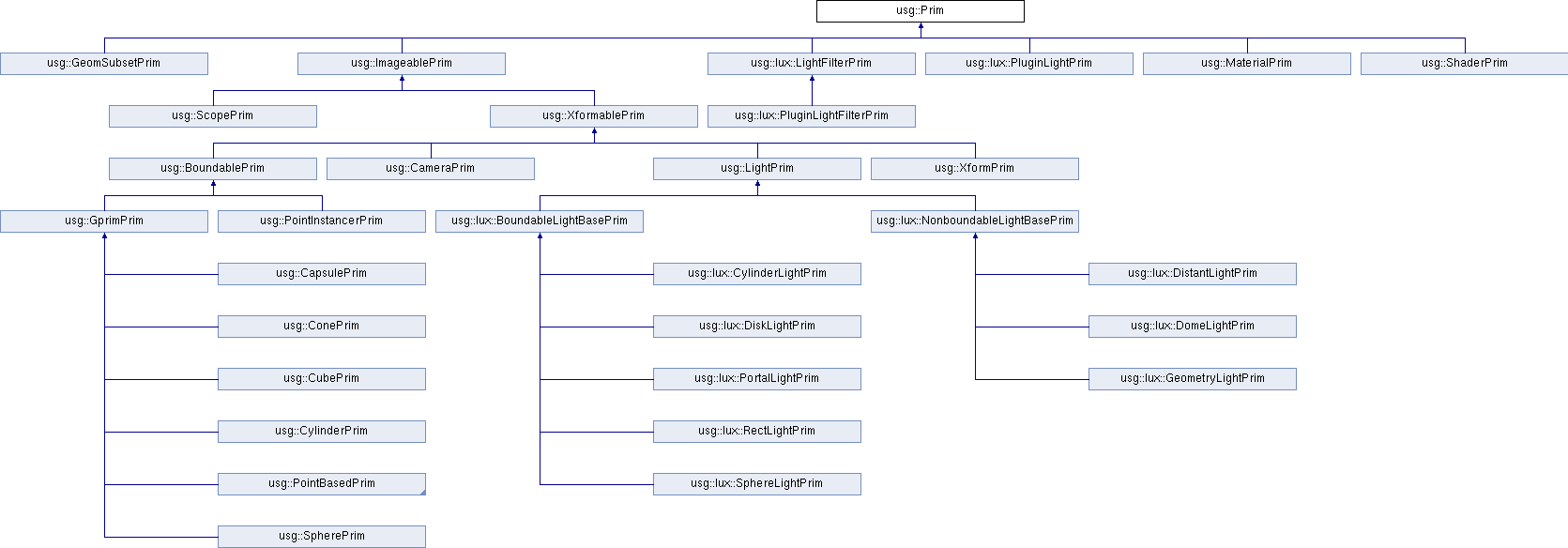
Reimplemented in usg::NurbsPatchPrim, usg::MeshPrim, usg::BasisCurvesPrim, usg::NurbsCurvesPrim, usg::lux::CylinderLightPrim, usg::lux::DomeLightPrim, usg::CameraPrim, usg::HermiteCurvesPrim, usg::lux::RectLightPrim, usg::lux::DistantLightPrim, usg::lux::PortalLightPrim, usg::lux::SphereLightPrim, usg::CurvesPrim, usg::PointsPrim, usg::lux::DiskLightPrim, usg::lux::GeometryLightPrim, usg::PointInstancerPrim, usg::PointBasedPrim, usg::CapsulePrim, usg::ConePrim, usg::CylinderPrim, usg::lux::PluginLightPrim, usg::CubePrim, usg::SpherePrim, usg::lux::PluginLightFilterPrim, usg::GprimPrim, usg::BoundablePrim, usg::ShaderPrim, usg::MaterialPrim, usg::XformablePrim, usg::XformPrim, usg::lux::LightFilterPrim, usg::ScopePrim, usg::GeomSubsetPrim, usg::ImageablePrim, usg::LightPrim, usg::lux::BoundableLightBasePrim, and usg::lux::NonboundableLightBasePrim.
| class Prim::SpecPrimHandle* usg::Prim::getSdfPrimSpec | ( | int | usd_version | ) |
If the Prim is bound to an SdfPrimSpec return a pointer to the underlying SdfPrimSpec object if the usd_version passed in matches the Usd version this library was built with, otherwise return null.
The version must match the one returned by usg::usdAPIVersion().
Caller should cast the returned pointer to an SdfPrimSpec* and possibly double-check its validity since a Prim can be created without a valid binding. However, if Prim::isValid() returns true then the underlying binding will also be valid.
| class Prim::UsdPrimHandle* usg::Prim::getUsdPrim | ( | int | usd_version | ) |
If the Prim is bound to a UsdPrim return a pointer to the underlying UsdPrim object if the usd_version passed in matches the Usd version this library was built with, otherwise return null.
The version must match the one returned by usg::usdAPIVersion().
Caller should cast the returned pointer to an UsdPrim* and possibly double-check its validity since a Prim can be created without a valid binding. However, if Prim::isValid() returns true then the underlying binding will also be valid.
|
static |
Creates a Prim definition in the owner Layer, returning a constructed reference. Convenience function that calls Layer::definePrim().
|
static |
Creates a Prim override in the owner Layer, returning a constructed reference. Convenience function that calls Layer::overridePrim().
|
static |
Creates the missing parent prims in a Prim path with a specific type.
Other define and override prim methods default to creating missing parent prims as untyped pure overs, which may cause the prim to act as if they doesn't exist.
Be careful with this method as it requires a composed source stage to determine whether a prim is 'missing' from the path or not, and this may lead to unexpected overhead costs when defining prims.
| Attribute usg::Prim::createIntrinsicAttr | ( | const Token & | name, |
| Value::Type | type, | ||
| TimeVariability | variability_hint = TimeVariability::Uniform |
||
| ) |
Creates and attaches an intrinsic(non-custom) attribute to this Prim. If the named Attribute object already exists returns it at its current value.
If this Prim has just been defined on a Layer then the new attribute will be defined on that Layer.
If this Prim is being edited then the attribute will be created on the editable Stage and saved to the Stage's current edit target Layer.
variability_hint is only declaring the expected time-variance of the new attribute. In practice this does not do much as setting time samples later on is not prohibited if the attribute is declared here as uniform.
| Attribute usg::Prim::createCustomAttr | ( | const Token & | name, |
| Value::Type | type, | ||
| TimeVariability | variability_hint = TimeVariability::Uniform |
||
| ) |
Creates and attaches a custom(arbitrary) attribute to this Prim. If the named Attribute object already exists returns it at its current value.
If this Prim has just been defined on a Layer then the new attribute will be defined on that Layer.
If this Prim is being edited then the attribute will be created on the editable Stage and saved to the Stage's current edit target Layer.
variability_hint is only declaring the expected time-variance of the new attribute. In practice this does not do much as setting time samples later on is not prohibited if the attribute is declared here as uniform.
| Attribute usg::Prim::createAttr | ( | const Token & | name, |
| Value::Type | type, | ||
| bool | is_custom = false, |
||
| TimeVariability | variability_hint = TimeVariability::Varying, |
||
| const Value & | defaultValue = Value() |
||
| ) |
Creates an attribute with the given name, type, temporal variability, and optionally setting the default value.
If the named Attribute object already exists the default value will still be set if provided.
variability_hint is only declaring the expected time-variance of the new attribute. In practice this does not do much as setting time samples later on is not prohibited if the attribute is declared here as uniform.
| Attribute usg::Prim::setAttr | ( | const Token & | name, |
| const T & | v, | ||
| const fdk::TimeValue & | time = fdk::defaultTimeValue() |
||
| ) |
Sets an existing attribute's value at a specific time. Returns a valid Attribute if successful otherwise an invalid one on failure.
This templated method does not support custom user data types, only the common ones found in the Value::Type 'Base data types' list.
Assumes the attrib has already been created and configured for the correct Value::Type and interpolation rate. Use createAttr() for this prior to calling setAttr().
If the attribute does not already exist setAttr() will create it as a custom uniform attribute using the default Value::Type corresponding to the data type passed in. For example if setting UVs you would likely want the attribute to be a TexCoord2fArray Value::Type, but this method will create it as a Float2Array.
To set array-variant types (FloatArray, Color3fArray, etc) pass in a std::vector. Many of the common array types are already defined in geo/scene/Array.h or in the vec/mat/box math types. For example to set an array of normals: Vec3fArray normalsArray; prim.setAttr(GeomTokens.primvars.normals, normalsArray, 100.0);
|
virtual |
Retrieves any overrides from the ShaderDesc and writes them to the matching Prim Attributes, optionally skipping any that have connections defined.
SchemaProperties tagged as 'usg_local' (a LocalProp) will not have the 'inputs:' prefix added to the property name so Schema overrides can be applied to generic attributes.
Returns false if any underlying error occurred.
| Relationship usg::Prim::getRelationship | ( | const Token & | name | ) | const |
If the named relationship exists on the Prim returns it otherwise returns an empty (invalid) Relationship object.
| bool usg::Prim::getRelationship | ( | const Token & | name, |
| Relationship & | rel | ||
| ) | const |
If the named relationship exists on the Prim fills in the provided Relationship object and return true, otherwise return false.
| ©2024 The Foundry Visionmongers, Ltd. All Rights Reserved. |

